
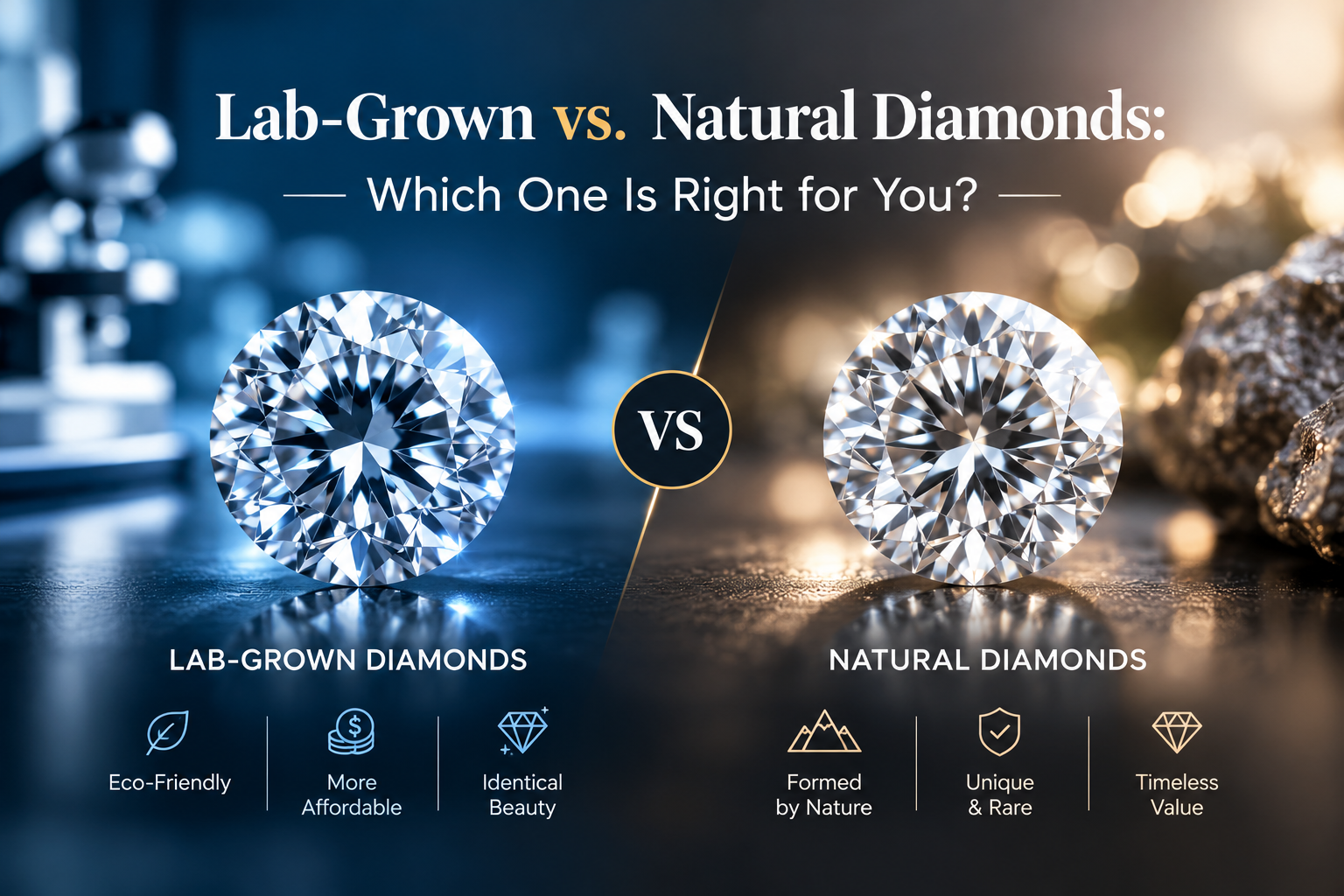
You've seen the price tags. You've heard the debates. And now you're standing at the crossroads of one of the most personal purchases you'll ever make — asking yourself a deceptively simple question: lab-grown or natural?
The stakes feel high. A diamond is more than a stone; it's a symbol, a milestone, sometimes a family heirloom. But the industry has changed dramatically in the last decade, and the "obvious" choice is no longer obvious. Lab-grown diamonds now account for 61% of all loose diamond engagement ring sales in the U.S. — up from just 2% in 2017. Meanwhile, natural diamonds still dominate the global market at roughly 80% of total volume.
So which one is right for you? There's no universal answer — only the answer that matches your values, budget, and expectations. This guide breaks down the data, the trade-offs, and the decision framework so you can choose with confidence.
Let's start with the numbers.
The Core Data: A Side-by-Side Comparison
Here's how lab-grown and natural diamonds stack up across the metrics that matter most.
| Comparison Dimension | Lab-Grown Diamonds | Natural Diamonds |
|---|---|---|
| Price (1 carat, F-VVS quality) | Approx. ₹45,000 (India retail) | Approx. ₹7.5 lakh (India retail) |
| Price example (3 carat flawless) | Less than $4,000 (U.S., early 2026) | Approx. $57,000 (U.S., early 2026) |
| Price gap | 30–70% cheaper on average; up to 80–90% in some categories | Baseline |
| Price trend | Wholesale prices down 93% since 2020, to approx. $100/carat | Relatively stable; some categories seeing slight declines |
| Resale recovery rate | Approx. 10–20% | Approx. 25–50% |
| U.S. engagement ring market share (2025) | 61% | 39% |
| Global diamond jewelry market share | Approx. 20–21% | Approx. 80% |
| Water consumption (per carat) | 18.5 gallons | 128 gallons |
| Energy consumption (per carat) | 36 kWh | 80 kWh |
| CO₂ emissions (per carat) | As low as 0.028 g (renewable energy) | Up to 57,000 g |
| Primary certification | IGI (full 4 Cs); GIA simplified grading since Oct 2025 | GIA (gold standard) |
What the data tells us: Lab-grown diamonds win decisively on price, environmental footprint, and market momentum. Natural diamonds retain an edge on resale percentage and global market share — but the gap is narrowing every year.
The Resale "Actual Loss" Calculation
Resale is where the conversation gets real. Let's use a 1.5-carat comparable-quality example to see what happens when you try to sell.
| Natural Diamond | Lab-Grown Diamond | |
|---|---|---|
| Purchase price | $10,000 | $1,800 |
| Resale recovery rate | 35% | 15% |
| Resale amount | $3,500 | $270 |
| Actual cash loss | $6,500 | $1,530 |
The key insight: Natural diamonds recover a higher percentage — but because the purchase price is so much higher, the absolute cash loss is far greater. If you never plan to resell and simply want to wear the diamond, lab-grown wins on pure cost efficiency. If resale liquidity matters to you, natural diamonds still have a functioning (if imperfect) secondary market.
Bottom line: Neither diamond is a reliable investment. But lab-grown is the more honest consumer purchase — you pay less, and you lose less in absolute terms.
The Environmental Question: Is Lab-Grown Really Greener?
The short answer: yes, generally — but it depends on the lab's energy source.
| Metric (per carat) | Lab-Grown | Natural (Mined) |
|---|---|---|
| Water consumption | 18.5 gallons | 128 gallons |
| Energy consumption | 36 kWh | 80 kWh |
| CO₂ emissions | As low as 0.028 g | Up to 57,000 g |
Lab-grown diamonds use roughly 86% less water and 55% less energy per carat than mining. Pandora has disclosed a carbon footprint of 12.58 kg CO₂e per carat for its lab-grown diamonds, claiming about 90% lower emissions than mined equivalents under specific renewable-energy production.
The caveat: Not all labs run on clean energy. A lab powered by a coal-heavy grid will have a much larger footprint than one using solar or hydro. If sustainability is your priority, ask the retailer about their energy source. "Lab-grown" alone doesn't guarantee "green" — it guarantees "not mined."
The Ethical Dimension
Lab-grown diamonds bypass mining entirely, which means they are inherently free from conflict-financing, labor abuses, and the environmental destruction associated with some natural diamond supply chains. Even with the Kimberley Process and other certification schemes, traceability in natural diamond supply chains remains imperfect.
For buyers who prioritize ethical sourcing, lab-grown offers a clear advantage: there is no mine, no excavation, and no conflict footprint. The ethical question shifts from "where was it mined?" to "how was the lab powered?" — a different, but more transparent, conversation.
That said, natural diamonds support the livelihoods of millions of people in mining communities worldwide. The ethical picture is not black and white — it depends on which supply chain you're buying into and what you value most.
The Certification Landscape Is Shifting
IGI (International Gemological Institute) remains the practical industry standard for lab-grown diamonds, applying the full 4 Cs (cut, color, clarity, carat) just as it does for natural stones. Its position is that consumers deserve full transparency.
GIA (Gemological Institute of America), long the gold standard for natural diamonds, changed course in October 2025. It stopped using the 4 Cs for lab-grown stones and replaced them with a simplified "Premium" or "Standard" two-tier description, effective February 2026. GIA's reasoning: more than 95% of lab-grown diamonds fall within an extremely narrow quality range, making detailed grading less meaningful.
What this means for you: Always buy with a certificate, and know which lab issued it and what standard was applied. A "Premium" GIA label means something different from a full IGI 4 Cs report. If detailed grading matters to you, IGI is currently the more informative option for lab-grown.
The Decision Framework: Which Diamond Is Right for You?
There's no universal right answer — only the right answer for you. Here's a simple framework to help you decide.
Choose Lab-Grown If You:
-
Want more diamond for your money — a larger carat weight or higher clarity for the same budget
-
See the diamond as a consumer purchase — something to wear and enjoy, not invest in
-
Value environmental and ethical attributes — significantly lower water, energy, and emissions
-
Are comfortable with near-zero resale value — and understand that the absolute loss is still smaller than with natural
-
Love the idea of innovation — a stone grown in weeks rather than formed over billions of years
Choose Natural If You:
-
Value geological rarity — a stone formed over 1–3 billion years carries a story no lab can replicate
-
Want better resale liquidity — even if returns aren't guaranteed, a secondary market exists
-
View the diamond as a long-term heirloom — something to pass down through generations
-
Are willing to pay a significant premium for natural origin
-
Prefer the traditional symbolism — the romance and heritage of mined diamonds
The Hybrid Option
You don't have to choose one or the other for everything. Many couples now buy a natural diamond for the engagement ring (the heirloom piece) and lab-grown diamonds for everyday jewelry (stud earrings, tennis bracelets, fashion rings). This approach balances sentiment, value, and practicality.
Common Myths, Debunked
Myth 1: "Lab-grown diamonds aren't real diamonds."
False. They are chemically, physically, and optically identical to mined diamonds — same carbon crystal structure, same 4 Cs grading. Only their origin differs.
Myth 2: "Lab-grown diamonds will turn yellow."
Outdated. Early-generation CVD stones sometimes had color stability issues, but modern production — especially with post-growth HPHT treatment — has largely resolved this. Today's stones are color-stable under normal wear.
Myth 3: "Lab-grown diamonds are bad for the diamond industry."
More accurately, they are reshaping it. They've expanded the market by making diamonds accessible to buyers who couldn't afford natural stones, and they've pushed the entire industry toward greater transparency and traceability.
Myth 4: "Natural diamonds are a safe investment."
Not reliably. Retail markups, certification costs, and the gap between purchase and resale prices mean most natural diamonds lose money when sold. They are a store of symbolic value, not financial value.
Myth 5: "Lab-grown diamonds are all identical."
False. Like natural diamonds, they vary widely in cut, color, clarity, and carat. Quality depends on the producer and the specific stone. Always buy with a certificate.
The Bottom Line
Lab-grown and natural diamonds are both real diamonds. They sparkle the same, last the same, and can be certified the same. The difference is in their value logic — and that logic should match your own priorities.
Lab-grown is the choice for buyers who want maximum sparkle for their budget, a lighter environmental footprint, and a modern, transparent approach. It's a consumer purchase in the truest sense — and a very good one.
Natural is the choice for buyers who value rarity, heritage, and the romance of "billions of years in the making." It's a premium purchase with imperfect but real resale liquidity.
Neither is wrong. Neither is "fake." Neither is a guaranteed investment. The right choice is the one that fits your life, your budget, and your values — not someone else's sales pitch.
Frequently Asked Questions
Q: Are lab-grown diamonds cheaper than natural diamonds?
Yes — roughly 30–70% cheaper on average, and up to 80–90% less in some categories.
Q: Do lab-grown diamonds hold resale value?
Minimal. Resale recovery is typically 10–20%, far below natural diamonds. Treat them as a consumer purchase, not an investment. That said, the absolute cash loss is often smaller with lab-grown because the purchase price is lower.
Q: Are lab-grown diamonds eco-friendly?
Generally yes — about 86% less water and 55% less energy per carat than mining. But the footprint depends on the producer's energy source (renewable vs. grid). Ask the retailer.
Q: Can you tell the difference with the naked eye?
No. Even trained jewelers need specialized equipment to distinguish them. Only a lab certificate reveals the origin.
Q: Should I buy lab-grown or natural for an engagement ring?
It depends on your priorities. Choose lab-grown for size, value, and ethics; choose natural for rarity, tradition, and resale liquidity. Many couples now mix both — natural for the ring, lab-grown for everyday pieces.
Still Deciding?
Read our full Lab-Grown Diamonds FAQ: Your Top 10 Questions Answered for a deeper dive into authenticity, certification, durability, and more — or explore our 2026 price data comparison to see exactly how the numbers break down for the carat weight you're considering.
Have a question we didn't cover? Drop it in the comments — we update this guide regularly.